
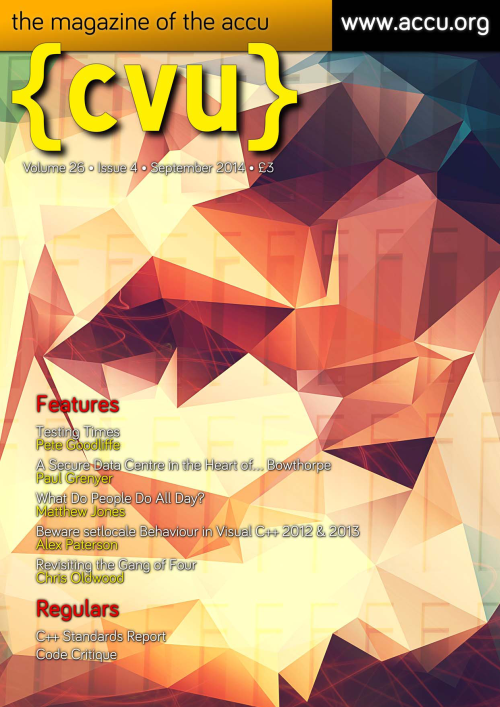
 Pete Goodliffe wrote this excellent article (login to ACCU may be required) on how to test software. It’s a decent summary on types of test, who should write them, when to write them, what to test and suitable test frameworks. Anyone looking for a robust argument for why effective testing is vital should refer to this.
ACCU: Testing Times
Filed under Programming
Book Review: One Shot, Lee Child
 This book was the first Jack Reacher thriller that I read, quite a few years ago. That copy came free with a copy of the London Evening Standard newspaper – it was probably about 50p at the time, but has since become a free paper handed out to the commuters of London every evening. I particularly wanted to re-read it because of the description of Jack Reacher that starts the book.

This should be very useful for any Hollywood Producers who are looking to cast Jack Reacher in a film – particularly his height (6′ 5″), weight (220-250lbs) and chest (50″). Obviously, this is a big guy, and missing that point would be bound to annoy any diehard Reacher fans.
This is actually one of the better Reacher thrillers. The perfect case is presented to the police, James Barr is the obvious perpetrator of a horrific killing spree in Indiana. Even worse for Barr, Jack Reacher has seen it on the news and is travelling there to ensure he doesn’t get away with it. Yet there’s more to the case than first appears, calling for Reacher’s special investigative skills and his own brand of blunt justice.

Filed under Book Review
Book Review: Mistress of Justice, Jeffery Deaver
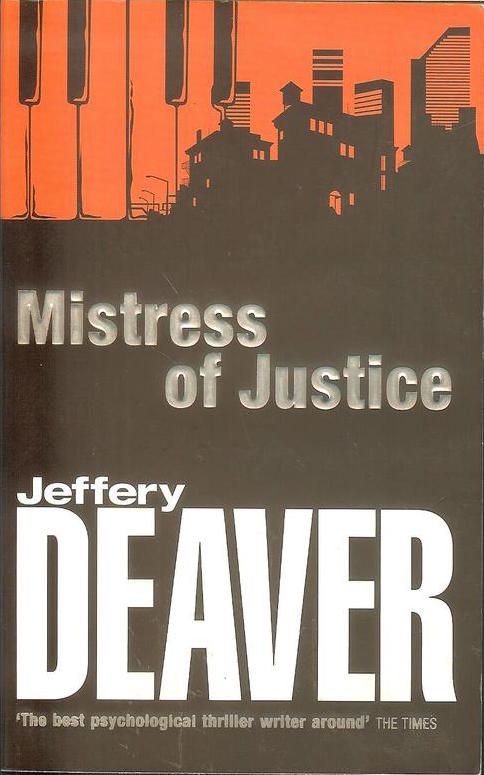 According to the author’s note, the edition that I read is his re-write of an earlier book by the same title. This is the second re-write that I’ve read recently, the other being by Nelson DeMille.
On first impressions, the book has a dull plot – a promissory note is missing, and Taylor Lockwood (the lead character) has been asked to find it somewhere in the law firm. The intrigue comes from the plotting around the firm, where competing factions are fighting over leadership. The stakes are high enough for Taylor to be at risk of physical attack – and she sees both senior figures and younger up-and-coming professionals risking everything to get ahead.
Filed under Book Review
Tutorial: Writing your first iOS App
I’ve finished working through this excellent introduction to writing iOS apps. Having written step-by-step guides for developers learning new software myself, it’s clear just how much work has gone into this guide to make it accurate as well as useful and informative.
- Having never used Xcode before, the guide did a good job of introducing the development environment and showing the workflow and how to manipulate the various views
- The FoodTracker application itself covers quite a few techniques – it’s a shame that some of the early lessons are later deleted as the app is built, but it’s a trade-off to get something to run quickly
- The frameworks clearly do much of the heavy-lifting. This reminds me of writing user interfaces in versions of Visual Basic – you didn’t need to know much of VB as a language, it was more about leveraging the tools to get a result
- Swift is very concise, parameter syntax takes some getting used to (some parameters have both external and internal names, which is esoteric) but even the passing parameters by name is starting to grow on me.
- It’s very cool that unit testing is integrated in the dev tools – I’m sure I’ll be writing plenty of tests against my data model when I work on this for real.
I have a couple of ideas for apps that I’d like to write for my new Apple Watch, so next I’m looking to try a tutorial specifically for a Watch app.
Filed under Programming, Swift
Book Review: The Scarecrow, Michael Connelly
 Jack McEvoy is a crime journalist whose position has been put at risk – meaning he has only two weeks left in the job. As well as handing over to a younger, cheaper journalist, he decides to go all out to write a final, brilliant story to show his employer what they’re missing. And perhaps he’ll be able to finish his first novel too.
Rather than a newspaper story, McEvoy uncovers a serial killer. He hooks up with Agent Rachel Walling of the FBI in order to investigate. Now, Walling has also appeared in other Connelly books with Harry Bosch – e.g. Echo Park. I love it when authors recycle characters across stories, Jeffrey Deaver does similar tricks.
The investigation focusses on a web hosting firm with a highly secure data centre. The description of “The Farm” (the grid of machines hosting sites) is quite interesting, although it’s a shame that the technicians are so stereotyped (not everyone that works with computer hardware is a long-haired hacker!).
It’s a pretty good story – hard not to have sympathy with McEvoy (who’s ex-wife is quite successful whilst he’s left jobless with few prospects), and there are sufficient twists to keep one’s interest.
Filed under Book Review
MIT develops file system with data guaranteed
Wired reports that MIT have used formal verification to write a file system that to probably will not lose data in the event of a crash.
Making sure that the file system can recover from a crash at any point is tricky because there are so many different places that you could crash. You literally have to consider every instruction or every disk operation
They used Coq, a proof assistant that enabled them to build the system from the ground up in a logically consistent manner.
Filed under Programming
Book Review: Protect & Defend, Vince Flynn
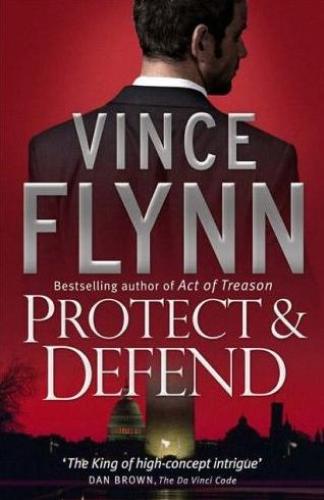 After the first Vince Flynn thriller that I read, my mind was made up not to read any more. However, my Dad recommended this one and I’m glad I persevered. This book features Mitch Rapp as a more established character. Where the earlier book sees him as a maverick agent, he’s now a senior figure, friend of the President and sage adviser on Middle Eastern affairs. Ok, so this is somewhat stretching believability, but it does make for an entertaining book!
What set this plot aside was that the storyline in Iran and ensuing political fallout was as intriguing as the action scenes where Rapp continues to be a master of his trade.
Filed under Book Review
Video: Animations
I was interested to see how animations are executed for Apple Watch apps. These videos shed some light on it: WWDC 2015 Apple Developer Videos. I watched:
- Layout and animation techniques for WatchKit
- Designing with Animation
It seems that a lot of the animations are ‘tricks’ achieved by tweaking the layout groups (either changing size, alignment or visibility). Other recommendations include writing skeleton apps to mock animations by switching between images put together in KeyNote – this enables choosing between competing ideas without taking the time to code them all individually.
Filed under Programming, Video
Programming is…
Bruce Dawson described programming as follows:
When I’m describing what I do for a living to non-programmers I sometimes say that I solve puzzles. I solve fascinating puzzles that are different every day, and there’s no answer key, and very often nobody else knows the solution. Whether it’s figuring out why code is slow, or why it is crashing, or how to make code simpler and better, it’s all puzzles, and I love it.
I think that’s a useful point of view. Whilst programmers need knowledge of some particular programming language and platform, it’s often the ability to solve puzzles that makes the star programmers stand out from the rest. An average programmer will often make a meal out of a simple task (whether it’s development or testing) because they can’t see an elegant way to a solution. The best programmers just get on with delivering quality, testing solutions without making a fuss – and they’re having a great time doing what they love!
Filed under Musing, Programming
Book Review: The Devil’s Star, Jo Nesbo
 This is another Harry Hole thriller from Jo Nesbo. There’s a clear chronological order to the books in this series – this one is the fifth and comes after his partner Ellen has been murdered. Harry is pitched against his nemesis Tom Waaler in an investigation into another serial killer.
As well as the excitement of the plot, Nesbo graphically depicts Harry’s fall into alcoholism as it threatens to destroy his relationship with Raquel and his career. The good news, though, is that this book isn’t as grisly as some of his other works.
Filed under Book Review

