
 I was lucky to attend the 2018 Mountbatten lecture at Savoy Place, London. This year’s speakers were Dr Julia Sutcliffe of BAE Systems and Air Marshal Julian Young of the Royal Air Force.
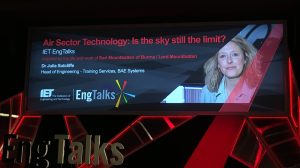 Dr Sutcliffe’s theme was “Air Sector Technology – is the sky still the limit?” and spoke of breakthrough technologies such as cloud computing and artificial intelligence as the 4th Industrial Revolution (after Steam, Electricity and Electronics/Computing). Her interest in military air systems is the generation of huge amounts of information for each single flight – not only from machine performance but also from crew health metrics. It would be a game changer to be able to receive the telemetry in real time so that appropriate action could be anticipated and actioned as soon as the plane returns to base. Other topics were unmanned systems for dirty or dangerous tasks and “Chemputation“, a method for using algorithms to build materials.
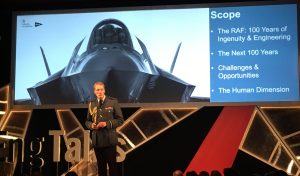 Air Marshal Young’s theme was “RAF 2118 – Engineering the next 100 years”. His point was that the Royal Air Force has been entwined with technology throughout its whole life, with innovation often the deciding factor in conflicts. Innovation has produced accuracy improvements in weapons delivery as well as amazing reliability for engines (such as the EJ200 in Typhoons). Novel technologies can also deliver increased operational performance, reduce production costs and reduce through-life savings – leaving more money to buy shiny new aeroplanes.
Interestingly, multi-core processors are not currently sanctioned for use in safety-critical systems because predictability is paramount. And whilst 3D printing could potentially allow spares to be produced “in theatre”, in practice it’s more reliable to produce them at home in a factory and send them in one of the daily flights transporting crew/cargo to the area.
The RAF Engineering teams breed a culture of innovation and “restless improvement” with each new generation.
 Suppose intelligence discovered that a terrorist organisation was planning a fresh atrocity that would shock the world, but had no further leads to prevent it. Then it might be appropriate to take the longest of shots – send an agent into Iraq to infiltrate that organisation at a senior level, in the hope that the secret is shared with him.
 This book is set in the early days of the space race. Scientists have assessed the risk of previously unknown organisms being released on Earth (either alien bacteria brought back to Earth by rockets or Earth-bound organisms changed by exposure to the environment of space). The result is Wildfire – an underground facility with multiple levels of increasing levels of sterilisation, in which the scientists would research any such contaminated material.
 This evening of talks was split into a set of Lightning Talks in the first half followed by a discussion about the Standard Library in the second half.
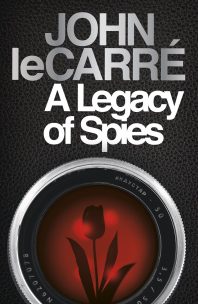 I was given a lovely hardback edition of this book for my birthday. Whilst this book stands alone, I’m sure I miss much of the sentiment portrayed by the lead character, Peter Guillaume, because I haven’t read any of the George Smiley series before.


