Tag Archives: C++

Alexandrescu Video – Three Optimization Tips for C++

Andrei Alexandrescu gave this talk on optimization tips for C++. He claims you should aim to:

  • Measure performance against a baseline
  • Choose algorithms that use the least heavyweight operations
  • Reduce array writes

The slides are also available.

Measuring gives you a leg up on experts who don’t need to measure

He also presents a handy ordering of different integral/floating point operations in terms of cost. The techniques (which he has internalised to give a gut feel of whether some improvement will produce a speed-up) are illustrated with a classic interview question (convert an integer to ascii) that is heavily used at Facebook.

The underlying message of this presentation is that the cost of one engineer spending time producing some pretty esoteric code with massive performance benefits is more than outweighed by the savings in terms of data centre costs (due to improved speed, you can scale back spend on servers).

Leave a comment

Filed under C++, Video

Lambda functions – recursion and other tricks

A few useful lambda function ideas, especially how to write a recursive lambda function in C++11:

Interestingly, lambdas can be recursive. For example, here’s a lambda that implements the fibonacci series using recursion:

function<int(int)> fib1 = [&fib1](int n) -> int
{
  if(n <= 2)
    return 1;
  else
    return fib1(n-1) + fib1(n-2);
}

Note that we had to actually name the lambda in order to implement the recursion. Without a name, how would you make the recursive call? This self-referencing places some restrictions on how a recursive lambda can be used; the lambda doesn’t refer to itself, it refers to fib1, which happens to be itself.

Leave a comment

Filed under C++

Herb Sutter Video – C++ Concurrency

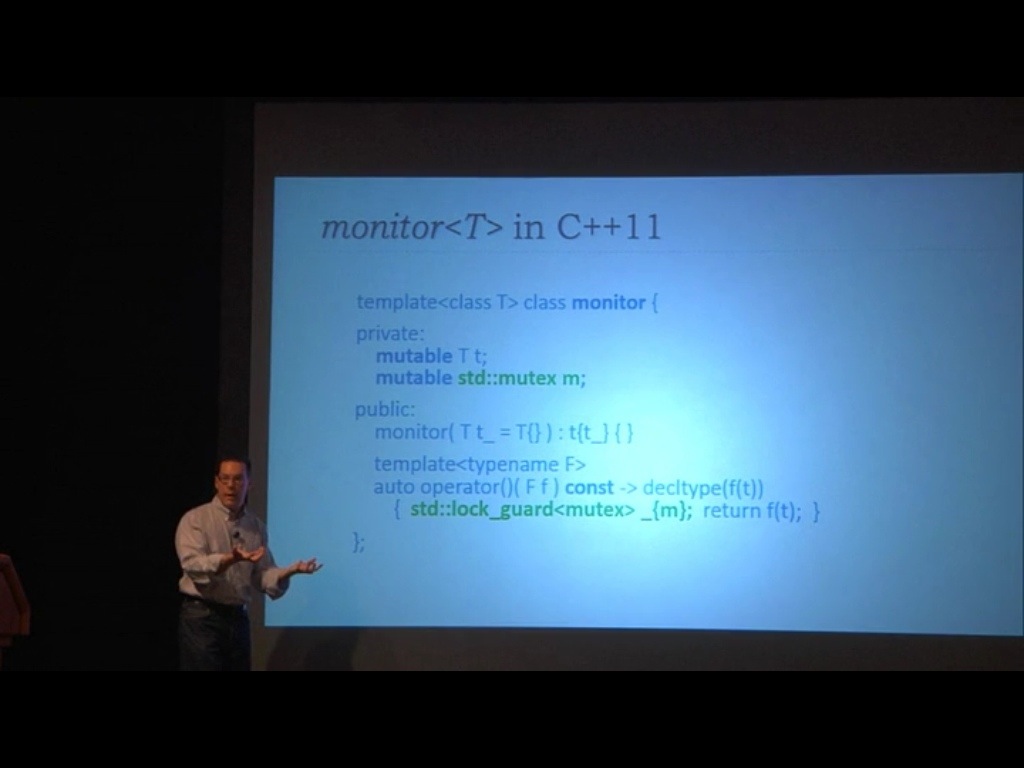
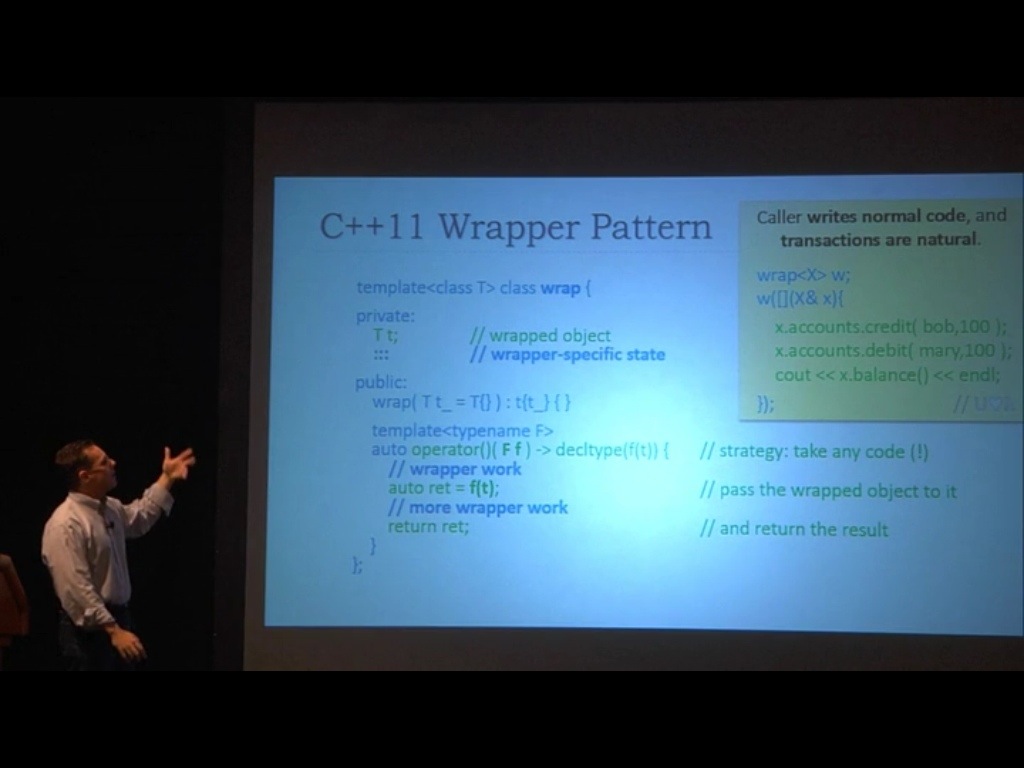
Another excellent video from Herb Sutter, this time on C++ Concurrency. The Monitor class is based on his Wrapper pattern
20130118-133301.jpg
and allows the caller to group related calls into a transaction, with synchronisation supplied via a mutex.
20130118-133722.jpg
The Concurrent class replaces the mutex with a concurrent_queue to avoid the caller blocking whilst the tasks complete.
20130118-133609.jpg
What’s especially elegant is ~Concurrent which pushes a done function onto message queue in order to signal not to wait for any more tasks (the concurrent_queue.pop() is assumed to wait until the next task is pushed). The done data member is not required to be atomic because it is only mutated on the worker thread, never on the calling thread.

1 Comment

Filed under C++, Video

Memory corruption due to C++ code incompatible with C++11 standard

I’m a big fan of C++11 and the new features that have become available, including move semantics.  However, our team found today that a code optimization which worked under VS 2005 was causing memory corruption under VS 2010.

The story goes back to a string holder class a bit like this (if you think BSTRs you’ll be on the right lines, but taking COM out of the picture makes the example clearer):

class CDeepCopy
{
protected:
  char* m_pStr;
  size_t m_length;

  void clone( size_t length, const char* pStr )
  {
    m_length = length;
    m_pStr = new char [m_length+1];
    for ( size_t i = 0; i < length; ++i )
    {
      m_pStr[i] = pStr[i];
    }
    m_pStr[length] = '';
  }

public:
  CDeepCopy() : m_pStr( nullptr ), m_length( 0 )
  {
  }

  CDeepCopy( const std::string& str )
  {
    clone( str.length(), str.c_str() );
  }

  CDeepCopy( const CDeepCopy& rhs )
  {
    clone( rhs.m_length, rhs.m_pStr );
  }

  CDeepCopy& operator=( const CDeepCopy& rhs )
  {
    if (this == &rhs)
      return *this;

    clone( rhs.m_length, rhs.m_pStr );
    return *this;
  }

  bool operator<( const CDeepCopy& rhs ) const
  {
    if (m_length < rhs.m_length)
      return true;
    else if (rhs.m_length < m_length)
      return false;

    return strcmp( m_pStr, rhs.m_pStr ) < 0;
  }

  virtual ~CDeepCopy()
  {
    delete [] m_pStr;
  }
};

CDeepCopy was used as the key into a map. For large data sets with heavily overlapping key values, this was inefficient because each lookup would entail the cost of a copy constructor – this was particularly expensive due to the heap operations. As an optimization, the following technique was used to avoid the copy constructor call in the event of an update operation, yet worked correctly if the operator[]() call led to an insertion.

class CShallowCopy : public CDeepCopy
  {
  public:

  CShallowCopy( const std::string& str ) : CDeepCopy()
  {
    m_pStr = const_cast<char*>(str.c_str());
    m_length = str.length();
  }

  ~CShallowCopy()
  {
    m_pStr = nullptr;
  }
};

So you could do an efficient lookup like this that only caused a deep copy if an insertion into the map was required instead of an update:

int _tmain(int argc, _TCHAR* argv[])
{
  std::map<CDeepCopy, int> entries;
  std::string hello( "Hello" );

  CDeepCopy key( hello );
  entries[key] = 1;

  // Named variable
  CShallowCopy key2( hello );
  entries[key2] = 2;

  // Unnamed temporary variable
  entries[ CShallowCopy( hello ) ] = 3;

  return 0;
}

This code worked as intended in VS2005. However, compiled under VS2010 we were seeing memory corruption in the final case (the one with the unnamed temporary). After some debugging, we realised that under C++11, std::map has an operator[]( KeyT&& key ), that is the key is an rvalue reference – and this form is called for our unnamed temporary case. That avoids calling our CDeepCopy copy constructor, and so the key in the map can be left referencing deallocated memory.

A simple workaround prevents this happening again – declare CDeepCopy( CDeepCopy&& ) as private but omit the definition – this means that the unnamed temporary usage does not compile.

Leave a comment

Filed under C++ Code

Herb Sutter Video – You think you know Const and Mutable

Herb Sutter has published his C++ and Beyond talk on Const and Mutable in C++ 11.

20130110-130728.jpg

20130110-130826.jpg

20130110-130953.jpg

1 Comment

Filed under C++, Video

QuickCheck for C++

I’ve used FsCheck with XUnit for writing and running unit tests, so will be interested to see how the concepts translate to C++ in QuickCheck++ and AutoCheck.

Leave a comment

Filed under C++, Programming

Impact of volatile and atomic on performance

Marc Brooker posted an interesting breakdown on the performance impact on use of volatile and atomic. He also points out that volatile alone doesn’t prevent concurrency issues – if you need synchronisation, then you need atomic.

Leave a comment

Filed under C++

Delegating Constructors in C++11

Here’s some code that tries out C++ 11 delegating constructors.  These were announced as part of Visual Studio in the November CTP and avoid the need to refactor common code out of constructors into an “init” function.  There are examples of their use in Stephan Levavej’s excellent video series too.

class Request
{
public:
  enum class Priority{ High, Medium, Low };
  static const Priority defaultPriority(){ return Priority::Low; }

  // Constructor with all parameters fully specified
  Request( Priority priority, const std::string& requestId ) :
      m_priority( priority ),
      m_requestId( requestId )
  {
    std::cout 
    << "Request( Priority priority, const std::string& requestId ) called: "
    << "RequestId " << m_requestId << ", "
    << "Priority " << toString( m_priority ) << "\n";
  }

  // Delegate to fully specified constructor above
  Request( const std::string& requestId ) : 
    Request( defaultPriority(), requestId )
  {
    std::cout 
      << "Request( const std::string& requestId ) called: "
      << "RequestId " << requestId << "\n";
  }

  // Contrived example to demonstrate chaining delegating constructors
  Request( const std::vector<int>& requestId ) : 
    Request( toString( requestId ) )
  {
    std::cout << "Request( const std::vector<int>& requestId ) called\n";
  }

  // Contrived example to show that ~Request() is called if the delegating constructor completed
  Request( Priority priority ) : 
    Request( priority, "Empty" )
  {
    throw std::exception( "This constructor is deprecated, RequestId field is now mandatory." );
  }
  ~Request()
  {
    std::cout 
      << "~Request() called:"
      << "RequestId " << m_requestId << ", "
      << "Priority " << toString( m_priority ) << "\n";
  }
private:
  std::string toString( const std::vector<int>& requestId )
  {
    std::string tmpId;
    for (auto elem : requestId)
    {
      if ( elem < 0 || 9 < elem )
        throw std::exception("Invalid request id, should be digits");
      tmpId.push_back(static_cast<char>(elem + '0'));
    }
    return tmpId;
 }

 std::string toString( Priority p )
 {
   if (p == Priority::Low ) return "Low";
   else if ( p == Priority::Medium ) return "Medium";
   else if ( p == Priority::High ) return "High";
   else
     throw std::exception( "Unexpected Priority" );
 }
 Priority m_priority;
 const std::string m_requestId;
};

And here’s a program that exercises the Request class (this uses musingstudio::initialize to conveniently initialize a standard container):

int _tmain(int argc, _TCHAR* argv[])
{
  std::cout << "\nCall fully specified constructor\n";
  Request fullySpecified( Request::Priority::High, "HeartTransplant-749553" );

  std::cout << "\nCall a delegating constructor\n";
  Request defaultPriority( "BookDelivery-5542" );

  std::cout << "\nCall chained delegating constructors\n";
  Request legacy( musingstudio::initialize<std::vector<int>>( { 1, 6 } ) );

  std::cout << "\nThis should throw without executing the destructor...\n";
  try
  {
    // This should throw due to -ve input, but does NOT execute ~Request()
    // because no constructor call completed
    Request invalid( musingstudio::initialize<std::vector<int>>( {-1} ) );
  }
  catch( const std::exception& exc )
  {
    std::cout << "ERROR: " << exc.what() << std::endl;
  }

  std::cout << "\nThis should throw and execute the destructor...\n";
  try
  {
    // This will throw because no requestId is not specified
    // (contrived example to show that ~Request() is executed
    // because the delegating constructor succeeded).
    Request noRequestId( Request::Priority::Low );
  }
  catch( const std::exception& exc )
  {
    std::cout << "ERROR: " << exc.what() << std::endl;
  }

  std::cout << "\nRemaining destructors...\n";

  return 0;
}

DelegatingConstructorsOutput
As with other Nov CTP features, Visual Studio intellisense hasn’t caught up yet, so expect to see red squiggly lines all over the code if you try this out.

What’s interesting is that it’s now possible for ~Request() to be called if a constructor fails to complete, as long as the delegatee (inner) constructor does complete.

Leave a comment

Filed under C++ Code

Setting max_load_factor to infinity in an unordered_set (to avoid re-hashing)

This StackOverflow post was cited on the ISO C++ blog.   Interesting that they set the max_load_factor to std::numeric_limits::infinity(), but the crux of the question is whether it’s ok to iterate over the newly inserted items as well as the original items.

Leave a comment

Filed under C++

Another new C++ 11 feature: constexpr

Danny Kalev wrote this post about constexpr:

constexpr is a new C++11 keyword that rids you of the need to create macros and hardcoded literals. It also guarantees, under certain conditions, that objects undergo static initialization. Danny Kalev shows how to embed constexpr in C++ applications to define constant expressions that might not be so constant otherwise.

The new C++11 keyword constexpr controls the evaluation time of an expression. By enforcing compile-time evaluation of its expression, constexpr lets you define true constant expressions that are crucial for time-critical applications, system programming, templates, and generally speaking, in any code that relies on compile-time constants.

constexpr is not available in Visual Studio 2010 or Visual Studio 2012 (not even with the November CTP).

Leave a comment

Filed under C++