How to choose whether to pass by const-reference or by value

There was a post on the ISOCpp blog last week about passing by const-reference or by value. The full StackOverflow post is Why do we copy then move? and another related post asks Are the days of passing by const ref over?.

First, as my friend and colleague Andy Sawyer pointed out in a conversation, taking a parameter by value leaks implementation detail out of the function so he recommends passing by const reference unless there’s a good reason not to.

Second, whilst passing by value presents the opportunity for the callee to store data using move semantics, the callee has to invoke that explicitly by calling std::move:


#include <string>
#include <iostream>

class A
{
public:
 A( const std::string& s ) :
 str_( s )
 {
   std::cout << "A: s='" << s << "', str_='" << str_ << "'\n";
 }
private:
 std::string str_;
};

class B
{
public:
 B( std::string s ) :
 str_( s )
 {
   std::cout << "B: s='" << s << "', str_='" << str_ << "'\n";
 }
private:
 std::string str_;
};

class C
{
public:
 C( std::string s ) :
 str_( std::move(s) )
 {
std::cout << "C: s='" << s << "', str_='" << str_ << "'\n";
 }
private:
 std::string str_;
};


int _tmain(int argc, _TCHAR* argv[])
{
 A a( "ConstReference" ); // Constructor(char*) then CopyConstructor
 B b( "PassByValue" ); // Constructor(char*) then CopyConstructor
 C c( "PassByValueAndMove" );// Constructor(char*) then MoveConstructor

return 0;
}

PassByValueAndMove

2 Comments

Filed under C++, C++ Code, Programming

Herb Sutter GotW6: Const and Mutable

This item covers ground Herb already presented in this video. He recommends that const member functions must be one of:

  • truly physically/bitwise const with respect to this object
  • internally synchronized so that if it does perform any actual writes to the object’s data, that data is correctly protected with a mutex or equivalent (or if appropriate are atomic) so that any possible concurrent non-const accesses by multiple callers can’t tell the difference.

Similarly, he asserts that the guidelines taught for C++98, that const means logically const but you had a free rein with internal data, is no longer true for C++11 with its memory model and thread safety specification.

This implies stricter best practice on use of mutable member variables. Any time you need to mutate data in a const member function, you should protect it with a synchronisation object to ensure thread safety.

Leave a comment

Filed under C++, Programming

Book Review: Persuader, Lee Child

Persuader, Lee ChildThe first Jack Reacher thriller I read was One Shot. It came free with a copy of the London Evening Standard. That’s when the Standard cost 50p, before it became a free paper. On the back of that, I went on to read all the Jack Reacher stories – and One Shot wasn’t even the best. The best stories are those in which he gets members from his team of Special Investigators back together.

Persuader is one of the stories in which Reacher hooks up with a team – in this case, some government agents. Reacher gets a second chance to take revenge on an old adversary, whilst helping the agents to crack a gang of suspected smugglers.

Why is Reacher such a compelling character? He’s incredibly violent yet he’s smart too – like a cross between Jean Claude van Damme and Sherlock Holmes. He shuns convention – no fixed abode, he wanders wherever fate takes him, without any care for material goods (except the ever-present folding toothbrush). He stays true to his own code of Justice. Once committed to a cause, he never backs off. Men respect him, women flock to him. What’s not to like?!

Four stars

Leave a comment

Filed under Book Review

Lambdas v Closures

Scott Meyers posted this explanation of the difference between a lambda and a closure.

The distinction between a lambda and the corresponding closure is precisely equivalent to the distinction between a class and an instance of the class. A class exists only in source code; it doesn’t exist at runtime. What exists at runtime are objects of the class type. Closures are to lambdas as objects are to classes. This should not be a surprise, because each lambda expression causes a unique class to be generated (during compilation) and also causes an object of that class type–a closure–to be created (at runtime).

He also managed to squeeze in mention of Universal References (in the context of the managing the lifetime of a closure).

1 Comment

Filed under C++, Programming

Mini Flash Crash

TheTradeNews.com reports on a mini-crash last week:

On Friday, the price of Anadarko Petroleum Corporation – which has a market capitalisation of US$45 billion – slid from US$90 to a single penny in the space of seconds, before returning to its pre-drop level.

Leave a comment

Filed under Finance

HFT Review interviews John Lowery, Electronic Trading Pioneer

HFT Review posted this interview with John Lowery, who it seems was there right at the start of electronic trading.

we were probably the first ever firm to offer co-location, high speed market data and a high speed transport system. I remember it was a great day when we first broke the one second barrier for an execution, we did 900 milliseconds and thought that was amazing! We were certainly way faster than anybody else on the street at that point; most firms were taking 10-15 seconds.

Leave a comment

Filed under Finance

Herb Sutter GotW 4: Class Mechanics

Herb Sutter’s GotW 4 on class mechanics is a treasure trove of best practice. It includes handy examples and canonical signatures for operator<, operator+ and the pre/post-increment operators.

I particularly liked his recommendation for implementing the postfix increment in terms of the prefix version:

complex operator++( int ) {
        auto temp = *this;
        ++real;
        return temp;
    }

Leave a comment

Filed under C++, Programming

Book Review: Foundation and Earth, Isaac Asimov

Foundation and EarthI must have read the Foundation novels years ago and was intrigued to spot this sequel in the book shop. It’s a brilliant read, packed full of technology, philosophy, planetary adventures and even politics. Highly recommended.
FiveStars

1 Comment

Filed under Book Review

Guru of the Week restarting from Item 1

Herb Sutter is reviewing his Guru of the Week series from item one, in the light of features in C++11 and C++14. This will form the backbone of a new issue of Exceptional C++.

Leave a comment

Filed under C++, Programming

How to profile performance by hand

I recently needed to profile some C++ code that was taking longer than expected to run. The code was running on a machine without a profiler, so I wrote a handy Timer class that dumps nested timings of each method. You can initialize it to write either to a file or to std::cout if the machine has a console.

I originally thought of this as a ‘Poor Man’s Profiler’, but having used it there are real benefits to taking the trouble to instrument your own code – you can use the file dumps to swiftly compare performance between code changes; you can print out performance statistics and take along to meetings.

#include <iostream>
#include <chrono>
class TimerOutput
{
  public:
    TimerOutput( const std::string file_path = "" ) :
      file_path_( file_path )
    {
      if ( !file_path_.empty() )
      {
        file_.open( file_path_ );
      }
    }

    std::ostream& Stream()
    {
      if (file_path_.empty() )
        return std::cout;
      else
        return file_;
    }

private:
    std::string file_path_;
    std::ofstream file_;
};

class Timer
{
public:
    Timer( const std::string& description ) :
      description_(description),
      start_(std::chrono::system_clock::now())
    {
        applyIndent();
        timer_output_->Stream() << "Start " << description_.c_str() << "\n";
        ++indent;
    }

    ~Timer()
    {
        --indent;
        const std::chrono::time_point<std::chrono::system_clock> finish = std::chrono::system_clock::now();
        auto milliseconds = std::chrono::duration_cast<std::chrono::milliseconds>(finish - start_).count();

        applyIndent();
        timer_output_->Stream() << "Finished " << description_.c_str()
            << ", took " << milliseconds << " (ms)" << "\n";
}

private:
    void applyIndent() const
    {
        for ( size_t i = 0; i < indent; ++i )
        {
            timer_output_->Stream() << "--";
        }
    }

    static size_t indent;
    static TimerOutput* timer_output_;
    std::string description_;
    const std::chrono::time_point<std::chrono::system_clock> start_;
};

#define INITIALIZE_PROFILING_TO_CONSOLE() \
  TimerOutput timer_output; \
  size_t Timer::indent = 0; \
  TimerOutput* Timer::timer_output_ = &timer_output;

#define INITIALIZE_PROFILING_TO_FILE( path ) \
  TimerOutput timer_output( path ); \
  size_t Timer::indent = 0; \
  TimerOutput* Timer::timer_output_ = &timer_output;

#define TIME( description, f ) \
  { \
    Timer profiler( description ); \
    f; \
  }

The obvious limitation of my solution is that it uses a class static to achieve the levels of nesting, so it won’t work on multi-threaded code – but it was great for my purposes. Here’s some sample code that shows it in action:

#include "stdafx.h"

#include <thread>
#include <fstream>

#include "..\MusingStudio\Profiler.h"

//INITIALIZE_PROFILING_TO_CONSOLE()
INITIALIZE_PROFILING_TO_FILE( "c:/temp/timings.txt" )

void method2()
{
  TIME( "method2",
    std::chrono::milliseconds short_wait( 5 );
    std::this_thread::sleep_for( short_wait );
  )
}

void method1()
{
 TIME( "method1",
  TIME( "loop",
    for ( int i = 0; i &lt; 5; ++i )
    {
        method2();
    }
  )

  TIME( "expensive algorithm",
    std::chrono::milliseconds wait( 100 );
    std::this_thread::sleep_for( wait );
  )
 )
}

void method3()
{
  TIME( "method3",
    std::chrono::milliseconds long_wait( 500 );
    std::this_thread::sleep_for( long_wait );
  )
}

int main(int argc, char* argv[])
{
  TIME( "main",
    method1();
    method3();
  )

  return 0;
}

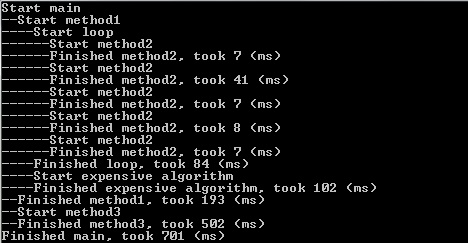
Here’s the output from the sample code:
Profiler

Leave a comment

Filed under C++, C++ Code, Programming