Category Archives: C++ Code

Unit Testing with GTest and GMock

In recent years, I’ve found myself writing less user interface code and more server code (typically COM servers that are exercised on client workstations or on nodes in a compute farm). Given the lack of a UI for driving and testing the code (excepting spreadsheets), automated tests are vital to achieve a high degree of code coverage.
The Art Of Unit Testing
Given that I’ve been doing this for years now, I was surprised to learn that I haven’t been writing unit tests, as I previously supposed. According to The Art of Unit Testing, the tests I’ve been writing are typically interaction tests. These are useful too, but unless a component can be tested in isolation with tests that run without delay due to network/database interaction, it isn’t a unit test.

Since reading the book, I’ve adopted the Google Test framework for both writing unit tests and implementing mock objects to accompany the tests. Without a good library for writing mock objects, you’re dragged straight back in to writing tests that call other objects in your library. With GMock, you can easily create mock objects and inject behaviour into them in order to test your server code in various scenarios. Using GTest and GMock is easy – just call RUN_ALL_TESTS() in main, and the framework discovers all the unit test you’ve written and launches them:

#include "gmock\gmock.h"
using namespace testing;

// Start writing unit tests here!

int _tmain(int argc, _TCHAR* argv[])
{
    ::InitGoogleMock( &argc, argv );
    return RUN_ALL_TESTS();
}

Here’s a simple example that defines a WeatherStation interface and a UserInterface class. We wish to test the UserInterface, but the weather station isn’t written yet – so we define a MockWeatherStation, and set up tests to invoke the UserInterface in different situations:

#include "gmock\gmock.h"

#include <iostream>
#include <list>
#include <memory>

class WeatherStation
{
public:
    virtual ~WeatherStation(){};

    typedef enum
    {
        North, South, East, West
    } Direction;

    typedef enum
    {
        Optimistic, Pessimistic
    } Outlook;

    // NB Semantics on wind deliberately ugly to show a neat feature in gmock
    virtual void wind( Direction* pDirection, double* strength ) const = 0;
    virtual double rainfall() const = 0;
    virtual std::string prediction( Outlook outlook ) const = 0;
};

class UserInterface
{
public:
    UserInterface( const std::shared_ptr<WeatherStation>& weather_station ) :
        weather_station_( weather_station )
    {
    }

    typedef enum
    {
        Heavy, Medium, Light
    } Range;

    Range rain()
    {
        auto rainfall = weather_station_->rainfall();
        if ( 0.0 <= rainfall && rainfall < 2.0 ) return Light;
        else if ( 2.0 <= rainfall && rainfall < 4.0 ) return Medium;
        else return Heavy;
    }

    Range wind()
    {
        WeatherStation::Direction direction;
        double strength;
        weather_station_->wind( &direction, &strength );

        if ( 0.0 <= strength && strength < 5.0 ) return Light;
        else if ( 5.0 <= strength && strength < 10.0 ) return Medium;
        else return Heavy;
    }

    std::pair<std::string, std::string> predict_range()
    {
        return std::make_pair( 
            weather_station_->prediction( WeatherStation::Optimistic ),
            weather_station_->prediction( WeatherStation::Pessimistic ) );
    }

private:
    std::shared_ptr<WeatherStation> weather_station_;
};

using namespace testing;

class MockWeatherStation : public WeatherStation
{
public:
    MOCK_CONST_METHOD0( rainfall, double() );
    MOCK_CONST_METHOD2( wind, void(WeatherStation::Direction*, double*) );
    MOCK_CONST_METHOD1( prediction, std::string( WeatherStation::Outlook ) );
};

TEST( WeatherStationUserInterface, rain_should_be_heavy )
{
    auto weather_station = std::make_shared<MockWeatherStation>();
    // GMock: specify a simple return value using Return(x)
    // Here, part of the test is that the Mock should be called once,
    // hence the 'WillOnce' call (more than one call would be an error).
    // If multiple calls should happen during the test, 
    // use 'WillRepeatedly' instead.
    EXPECT_CALL( *weather_station, rainfall() )
        .WillOnce( Return(5.0) );
    UserInterface ui( weather_station );
    EXPECT_EQ( UserInterface::Heavy, ui.rain() );
}

TEST( WeatherStationUserInterface, wind_should_be_light )
{
    auto weather_station = std::make_shared<MockWeatherStation>();
    // GMock: specify out parameter values using SetArgPointee
    EXPECT_CALL( *weather_station, wind(_,_) )
        .WillOnce( DoAll( SetArgPointee<0>( WeatherStation::North ),
                          SetArgPointee<1>( 0.5 )) );
    UserInterface ui( weather_station );
    EXPECT_EQ( UserInterface::Light, ui.wind() );
}

TEST( WeatherStationUserInterface, predictions_are_displayed )
{
    auto weather_station = std::make_shared<MockWeatherStation>();
    // GMock: inject more complex logic using C++11 lambdas,
    // and pattern match on the input value
    EXPECT_CALL( *weather_station, prediction(WeatherStation::Optimistic) )
        .WillOnce( Invoke( []( WeatherStation::Outlook _ ) -> std::string
            {
                return "Sunny";
            }) );
    EXPECT_CALL( *weather_station, prediction(WeatherStation::Pessimistic) )
        .WillOnce( Invoke( []( WeatherStation::Outlook _ ) -> std::string
            {
                return "Overcast";
            }) );

    UserInterface ui( weather_station );
    auto predicted_range = ui.predict_range();
    EXPECT_EQ( "Sunny", predicted_range.first );
    EXPECT_EQ( "Overcast", predicted_range.second );
}

When you run the executable, it’s easy to spot if the tests pass or fail:
WeatherStationOutput

As a bonus, Visual Studio 2012 has neat integration for GoogleTest:
WeatherStation

See also

7 Comments

Filed under C++, C++ Code, Programming

C++: Race conditions and Data races

According to this discussion on Stack Overflow, we should make a distinction between race conditions and data races. This blog post defines the terms and gives a neat example where the code is modified to exhibit zero, one or both behaviours.

Here’s an example of a race condition – the ordering of the execution affects the outcome (this can occur if one thread checks a value then performs an action, giving another thread the change to mutate the variable in between):

if (x == 5) // The "Check"
{
   y = x * 2; // The "Act"

   // If another thread changed x in between "if (x == 5)" and "y = x * 2" above,
   // y will not be equal to 10.
}

And here’s an example of a data race – a variable is mutated by multiple threads without synchronisation:

// Execute this function on five threads simultaneously
for ( int i = 0; i < 10000; i++ )
{
   x = x + 1; 
}

In both cases, use of a synchronisation object across all the threads involved (e.g. a mutex) would address the issue.

Leave a comment

Filed under C++, C++ Code, Programming

C++: Function overload preferences

The function overload rules in C++ are sometimes surprising. Herb Sutter wrote an excellent Guru of the Week article on function overload rules some time ago, but here’s some code to differentiate between some of the common overloads:

#include <iostream>
#include <string>

template<typename T>
void foo(T t)
{
    std::cout << "Generic Template function: " << t << "\n";
}

template<>
void foo<int>(int i)
{
    std::cout << "Function template specialization for int: " << i << "\n";
}

template<>
void foo<bool>(bool b)
{
    std::cout << "Function template specialization for bool: " << b << "\n";
}

void foo( double d )
{
    std::cout << "Non-template overload for double: " << d << "\n";
}

void foo( int i )
{
    std::cout << "Non-template overload for int: " << i << "\n";
}

int main()
{
    std::string s = "Hello, World";
    foo(s); // Calls generic template

    bool b = true;
    foo(b); // Calls template specialization

    double d = 1.0;
    foo(d); // Exact match to non-template overload

    int i = 0;
    foo(i); // Exact match (better than template specialization)

    short sh = 255;
    foo(sh); // Not exact match, calls generic template

    return 0;
}

FunctionOverloadOutput

Leave a comment

Filed under C++, C++ Code, Programming

How to implement a “virtual” operator<

In order to support a collection of heterogenous objects, I implemented a std::set<std::shared_ptr<Base>> then inherited the derived classes from Base.  That works fine, except that the ordering and uniqueness is controlled by the object addresses, not the values of the derived objects.  Ideally, one would make operator< virtual on Base, but that won’t work here because the signature of operator< for each of the derived classes is different:

bool Base::operator<( const Base& rhs ) const
{  /* implementation */ }

bool A::operator<(const A& rhs ) const
{ /* implementation */  }

bool B::operator<(const B& rhs ) const
{ /* implementation */  }

Instead, this solution follows the “Non-Virtual Interface” idiom and leaves operator< non-virtual. Instead, operator< delegates to a separate virtual method, compares_less. In order to provide a strict-weak-ordering, the objects of distinct types need to be handled too – it’s not enough to fall back to comparing pointer addresses (the addresses could provide an inconsistent ordering).  Here, inter-type comparisons are handled by ordering on the type name (supplied by another virtual method).

// LessThan.cpp : Defines the entry point for the console application.
//

#include "stdafx.h"

#include <iostream>
#include <set>
#include <string>

template<typename Container>
void dump( const Container& elements )
{
  for ( auto it = elements.begin(); it != elements.end(); ++it )
  {
    if ( it != elements.begin() )
    {
      std::cout << ", ";
    }
    std::cout << (*it);
  }
  std::cout << std::endl;
}

class Base
{
public:
  bool operator<( const Base& rhs ) const
  {
    return this->compares_less( rhs );
  }

  virtual std::ostream& dump( std::ostream& os ) const = 0;

  virtual bool compares_less( const Base& rhs ) const = 0;
  virtual std::string type_name() const = 0;
};

class A : public Base
{
  int a_;
public:
  A(int a) : a_(a)
  {}

  int a() const { return a_; }

  virtual std::ostream& dump( std::ostream& os ) const
  {
    os << a_;
    return os;
  }

  virtual bool compares_less( const Base& rhs ) const
  {
    if ( auto pA = dynamic_cast<const A*>( &rhs ) )
    {
      return a_ < pA->a_;
    }
    return this->type_name() < rhs.type_name();
  }

  virtual std::string type_name() const
  {
    return "A";
  }
};

class B : public Base
{
  std::string b_;
public:
  B( std::string b ) : b_(b)
  {}

  std::string b() const { return b_; }

  virtual bool compares_less( const Base& rhs ) const
  {
    if ( auto pB = dynamic_cast<const B*>( &rhs ) )
    {
      return b_ < pB->b_;
    }
    return this->type_name() < rhs.type_name();
  }

  virtual std::string type_name() const
  {
    return "B";
  }

  virtual std::ostream& dump( std::ostream& os ) const
  {
    os << b_;
    return os;
  }
};

std::ostream& operator<<( std::ostream& os, const std::shared_ptr<Base>& b )
{
  b->dump( os );
  return os;
}

struct LessThan
{
  bool operator()( const std::shared_ptr<Base>& lhs, const std::shared_ptr<Base>& rhs ) const
  {
    return *lhs < *rhs;
  }
};

int _tmain(int argc, _TCHAR* argv[])
{
  std::set<std::shared_ptr<Base>, LessThan> elements;

  elements.insert( std::make_shared<A>( 1 ) );
  elements.insert( std::make_shared<A>( 10 ) );
  elements.insert( std::make_shared<B>( "World" ) );
  elements.insert( std::make_shared<A>( 7 ) );
  elements.insert( std::make_shared<B>( "C++ says" ) );
  elements.insert( std::make_shared<A>( 3 ) );
  elements.insert( std::make_shared<B>( "Hello" ) );
  elements.insert( std::make_shared<A>( 5 ) );

  dump( elements );

  return 0;
}

Here’s the output, showing that the A’s and B’s are ordered as expected:
VirtualLessThanOutput

Leave a comment

Filed under C++, C++ Code, Programming

How to serialize a COM object as a Base64 byte array

A component I’m working on needs to be able to serialize its data via JSON.  That’s fine for scalars, arrays and maps, but we also needed to be able to serialize COM objects (there’s a large legacy codebase underneath, much of which is deployed via COM).  It turns out ATL provides API functions for Base 64 encoding (which was a surprise to me and a number of my colleagues).  Here’s some code to make calling it easier (I’ve replaced the production code error handling with simple strings):

std::string to_base_64(int byte_length, const void* bytes  )
{
  if (bytes == 0)
    throw "ToBase64 called with zero bytes";
  
  ATL::CStringA base64;
  int base64_length = ATL::Base64EncodeGetRequiredLength(byte_length);

  if(!ATL::Base64Encode(static_cast<const BYTE*>(bytes), 
                        byte_length, 
                        base64.GetBufferSetLength(base64_length), 
                        &base64_length))
    throw "ATL::Base64Encode failed";

  base64.ReleaseBufferSetLength(base64_length);
  return static_cast<const char*>(CT2A(base64));
}

std::pair<size_t,std::unique_ptr<BYTE>> from_base_64( const std::string& encoded )
{
  // Predict length needed for decoding
  int decoded_length = Base64DecodeGetRequiredLength( encoded.size() );
  std::unique_ptr<BYTE> buffer( new BYTE[decoded_length] );

  // Actual decoded-length may be different to that predicted - method overwrites the value
  if (!Base64Decode(encoded.c_str(), encoded.size(), buffer.get(), &decoded_length))
  {
    throw "ATL::Base64Decode failed";
  }

  return std::make_pair( decoded_length, std::move(buffer) );
}

That leaves the requirement to turn a serializable COM object into a byte array.  The following code does the job provided the COM object implements IPersistStream:

std::pair<size_t, std::unique_ptr<BYTE>> object_to_bytes( IUnknown* pUnk )
{
  // Create an in-memory stream, HGlobalMem will be allocated internally
  HRESULT hr;
  CComPtr<IStream> pIStream;

  if (FAILED(hr = CreateStreamOnHGlobal(0, TRUE, &pIStream)))
    throw "Could not CreateStreamOnHGlobal";

  CComPtr<IPersistStream> pPersistStream;
  if (FAILED(hr = pUnk->QueryInterface(IID_IPersistStream, &pPersistStream ) )
    throw "Failed to QI to IPersistStream";

  CLSID clsid;
  if (FAILED(hr = pPersistStream->GetClassID(&clsid) )
    throw "Failed to get clsid";

  // Serialise CLSID into stream
  if (FAILED(hr = WriteClassStm( pIStream, clsid )))
    throw "WriteClassStm failed";

  // Serialise object into stream
  if (FAILED(hr = pPersistStream->Save( pIStream, TRUE ) )
    throw "Save object into IPersistStream failed";

  // Find out how big the stream is
  LARGE_INTEGER liStart = {0};
  if (FAILED(hr = pIStream->Seek( liStart, STREAM_SEEK_SET, NULL ) )
    throw "IPersistStream::Seek failed";

  STATSTG statstg;
  memset( &statstg, 0, sizeof(statstg) );

  if (FAILED(hr = pIStream->Stat( &statstg, STATFLAG_NONAME ) )
    throw "IPersistStream::Stat failed";

  // Populate a byte array from the stream
  std::unique_ptr<BYTE> buffer( new BYTE[statstg.cbSize.LowPart] );
  unsigned long size_read;
  if (FAILED(hr = pIStream->Read( (void*)buffer.get(), statstg.cbSize.LowPart, &size_read ) )
    throw "IPersistStream::Read failed";

  ASSERT( size_read == statstg.cbSize.LowPart );

  return std::make_pair( size_read, std::move(buffer) );
}

CComPtr<IUnknown> bytes_to_object( size_t length, void* bytes )
{
  HRESULT hr;
  CComPtr<IStream> pIStream;

  HGLOBAL handle = GlobalAlloc( GMEM_MOVEABLE | GMEM_NODISCARD, length );

  if (FAILED(hr = CreateStreamOnHGlobal(handle, TRUE, &pIStream)))
    throw "Could not CreateStreamOnHGlobal";

  unsigned long size_written;
  if (FAILED(hr = pIStream->Write( bytes, length, &size_written ) )
    throw "Failed to write to stream";

  // Reset the stream
  LARGE_INTEGER liStart = {0};

  if (FAILED(hr = pIStream->Seek( liStart, STREAM_SEEK_SET, NULL ) )
    throw "IPersistStream::Seek failed";

  // Serialise CLSID out of stream
  CLSID clsid;

  if (FAILED(hr = ReadClassStm( pIStream, &clsid )))
    throw "ReadClassStm failed";

  // Create object from the clsid and stream from IStream into the object, using IPersistStream
  CComPtr<IUnknown> pUnk;
  if (FAILED(hr = ::CoCreateInstance(clsid, NULL, CLSCTX_ALL, &pUnk ) )
    throw "Failed to CoCreate clsid";

  CComPtr<IPersistStream> pStream;
  if (FAILED(hr = pUnk->QueryInterface(IID_IPersistStream, &pStream ) )
    throw "Failed to QI to IPersistStream";

  if (FAILED(hr = pStream->Load( pIStream ) )
    throw "IPersistStream::Load failed";

  return pUnk;
}

Then it’s a matter of putting the methods together to achieve a simple API:

std::string to_base64_encoded_byte_array( IUnknown* pUnk )
{
  auto bytes = object_to_bytes( pUnk );
  return to_base_64( bytes.first, bytes.second.get() );
}

CComPtr<IUnknown> from_base64_encoded_byte_array( const std::string& encoded)
{
  auto bytes = from_base_64( encoded );
  return bytes_to_object( bytes.first, bytes.second.get() );
}

Leave a comment

Filed under C++, C++ Code, Programming

How to downcast a shared_ptr

A lot of the codebase I work on is deployed as COM servers. This means that it isn’t uncommon to pass an array of objects as an of pointers to base (i.e. IUnknown) and then downcast to the specific interface you want using QueryInterface.

I found myself in a similar situation with some more modern C++, where I had a std::vector<std::shared_ptr> and wanted to convert each pointer to a shared_ptr in order to call into some API method. The question is – if you have a std::shared_ptr<T1>, how to cast it to a std::shared_ptr<T2>  (for suitably related T1 and T2)?

This question was already asked on StackOverflow and the answers pointed me at std::dynamic_pointer_cast and std::static_pointer_cast, which are analogous to static_cast/dynamic_cast for raw pointers.

class B
{
public:
  virtual void Print(){ std::cout << "Object type B\n"; }
  virtual ~B(){};
};

class C : public B
{
public:
  virtual void Print(){ std::cout << "Object type C\n"; }
  void BehaveLikeC()  {std::cout << "Behave like C\n";}
};

class D : public B
{
public:
  virtual void Print(){ std::cout << "Object type D\n"; }
  void BehaveLikeD() { std::cout << "Behave like D\n"; }
};

void DoSomething( const std::shared_ptr<D>& d )
{
    d->BehaveLikeD();
}

int _tmain(int argc, _TCHAR* argv[])
{
  std::vector<std::shared_ptr<b>> elements;
  elements.push_back( std::make_shared<C>() );
  elements.push_back( std::make_shared<D>() );

  // Call base class method on all elements
  std::for_each( elements.begin(), elements.end(),
    []( const std::shared_ptr<b>& b ){ b->Print(); });

  // Call C behaviour on all C elements
  for ( size_t i = 0; i < elements.size(); ++i )
  {
    auto c = std::dynamic_pointer_cast( elements[i] );
    if (c ){ c->BehaveLikeC(); }

    auto d = std::dynamic_pointer_cast<D>( elements[i] );
    if (d){ DoSomething(d); }
  }

  return 0;
}

1 Comment

Filed under C++, C++ Code, Programming

How to choose whether to pass by const-reference or by value

There was a post on the ISOCpp blog last week about passing by const-reference or by value. The full StackOverflow post is Why do we copy then move? and another related post asks Are the days of passing by const ref over?.

First, as my friend and colleague Andy Sawyer pointed out in a conversation, taking a parameter by value leaks implementation detail out of the function so he recommends passing by const reference unless there’s a good reason not to.

Second, whilst passing by value presents the opportunity for the callee to store data using move semantics, the callee has to invoke that explicitly by calling std::move:


#include <string>
#include <iostream>

class A
{
public:
 A( const std::string& s ) :
 str_( s )
 {
   std::cout << "A: s='" << s << "', str_='" << str_ << "'\n";
 }
private:
 std::string str_;
};

class B
{
public:
 B( std::string s ) :
 str_( s )
 {
   std::cout << "B: s='" << s << "', str_='" << str_ << "'\n";
 }
private:
 std::string str_;
};

class C
{
public:
 C( std::string s ) :
 str_( std::move(s) )
 {
std::cout << "C: s='" << s << "', str_='" << str_ << "'\n";
 }
private:
 std::string str_;
};


int _tmain(int argc, _TCHAR* argv[])
{
 A a( "ConstReference" ); // Constructor(char*) then CopyConstructor
 B b( "PassByValue" ); // Constructor(char*) then CopyConstructor
 C c( "PassByValueAndMove" );// Constructor(char*) then MoveConstructor

return 0;
}

PassByValueAndMove

2 Comments

Filed under C++, C++ Code, Programming

How to profile performance by hand

I recently needed to profile some C++ code that was taking longer than expected to run. The code was running on a machine without a profiler, so I wrote a handy Timer class that dumps nested timings of each method. You can initialize it to write either to a file or to std::cout if the machine has a console.

I originally thought of this as a ‘Poor Man’s Profiler’, but having used it there are real benefits to taking the trouble to instrument your own code – you can use the file dumps to swiftly compare performance between code changes; you can print out performance statistics and take along to meetings.

#include <iostream>
#include <chrono>
class TimerOutput
{
  public:
    TimerOutput( const std::string file_path = "" ) :
      file_path_( file_path )
    {
      if ( !file_path_.empty() )
      {
        file_.open( file_path_ );
      }
    }

    std::ostream& Stream()
    {
      if (file_path_.empty() )
        return std::cout;
      else
        return file_;
    }

private:
    std::string file_path_;
    std::ofstream file_;
};

class Timer
{
public:
    Timer( const std::string& description ) :
      description_(description),
      start_(std::chrono::system_clock::now())
    {
        applyIndent();
        timer_output_->Stream() << "Start " << description_.c_str() << "\n";
        ++indent;
    }

    ~Timer()
    {
        --indent;
        const std::chrono::time_point<std::chrono::system_clock> finish = std::chrono::system_clock::now();
        auto milliseconds = std::chrono::duration_cast<std::chrono::milliseconds>(finish - start_).count();

        applyIndent();
        timer_output_->Stream() << "Finished " << description_.c_str()
            << ", took " << milliseconds << " (ms)" << "\n";
}

private:
    void applyIndent() const
    {
        for ( size_t i = 0; i < indent; ++i )
        {
            timer_output_->Stream() << "--";
        }
    }

    static size_t indent;
    static TimerOutput* timer_output_;
    std::string description_;
    const std::chrono::time_point<std::chrono::system_clock> start_;
};

#define INITIALIZE_PROFILING_TO_CONSOLE() \
  TimerOutput timer_output; \
  size_t Timer::indent = 0; \
  TimerOutput* Timer::timer_output_ = &timer_output;

#define INITIALIZE_PROFILING_TO_FILE( path ) \
  TimerOutput timer_output( path ); \
  size_t Timer::indent = 0; \
  TimerOutput* Timer::timer_output_ = &timer_output;

#define TIME( description, f ) \
  { \
    Timer profiler( description ); \
    f; \
  }

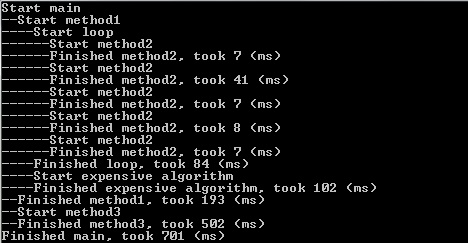
The obvious limitation of my solution is that it uses a class static to achieve the levels of nesting, so it won’t work on multi-threaded code – but it was great for my purposes. Here’s some sample code that shows it in action:

#include "stdafx.h"

#include <thread>
#include <fstream>

#include "..\MusingStudio\Profiler.h"

//INITIALIZE_PROFILING_TO_CONSOLE()
INITIALIZE_PROFILING_TO_FILE( "c:/temp/timings.txt" )

void method2()
{
  TIME( "method2",
    std::chrono::milliseconds short_wait( 5 );
    std::this_thread::sleep_for( short_wait );
  )
}

void method1()
{
 TIME( "method1",
  TIME( "loop",
    for ( int i = 0; i &lt; 5; ++i )
    {
        method2();
    }
  )

  TIME( "expensive algorithm",
    std::chrono::milliseconds wait( 100 );
    std::this_thread::sleep_for( wait );
  )
 )
}

void method3()
{
  TIME( "method3",
    std::chrono::milliseconds long_wait( 500 );
    std::this_thread::sleep_for( long_wait );
  )
}

int main(int argc, char* argv[])
{
  TIME( "main",
    method1();
    method3();
  )

  return 0;
}

Here’s the output from the sample code:
Profiler

Leave a comment

Filed under C++, C++ Code, Programming

Herb Sutter – complex initialisation for a const variable

Herb Sutter provided this handy use of lambdas to initialise a const variable that needs some logic:

const int i = [&]{

    int i = some_default_value;

    if(someConditionIstrue)
    {
        Do some operations and calculate the value of i;
        i = some calculated value;
    }

    return i;

} (); // note: () invokes the lambda!

It requires that the compiler can determine the type of the lambda even though it isn’t a simple return – that’s due to be finalised in C++14 but is supported in some compilers already.

Leave a comment

Filed under C++, C++ Code, Programming

Using std::tie to implement operator< (by Anthony Williams at ACCU 2013)

I’ve used std::tie to unbind the underlying data from a std::tuple in the past:

auto t = std::make_tuple( 1, 42, 100 );
int a, b, c;
std::tie( a, b, c ) = t;

But I hadn’t seen this handy trick for using std::tie to implement operator<

#include <tuple>

struct S
{
  S(int a_, int b_, int c_) : a(a_), b(b_), c(c_)
  {}

  int a;
  int b;
  int c;
};

bool operator<( const S& lhs, const S& rhs )
{
  return std::tie( lhs.a, lhs.b, lhs.c )
       < std::tie( rhs.a, rhs.b, rhs.c );
}

int main()
{
  S s1( 1, 2, 3), s2 ( 1, 2, 4 ), s3 ( 0, 2, 3);

  std::cout << "s1 should be less than s2: " << (s1 < s2) << "\n"
            << "s3 should be less than s1: " << (s3 < s1) << "\n";

  return 0;
}

Notice that std::tie does not copy the variables (as per the earlier example, it takes them by reference). You can also mimic the use of use of underscore in F#

let f i = (i, i*2, i*4)
let a, _, c = f 5

using std::ignore

auto f = []( int i){ return std::tuple(i, i*2, i*4); }
int a, b;
std::tie( a, std::ignore, b ) = f( 5 );

5 Comments

Filed under C++ Code